
Supply Chains have been living in darkness
Supply Chains Operate Blind When Context and Decision History Live Outside Your Systems
SUPPLY CHAIN

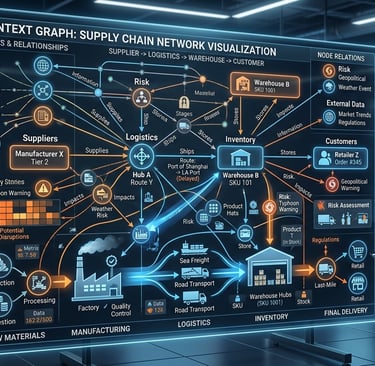
Supply chains operate blind when the current context and the history of decisions live outside your systems; capturing both field interactions and decision traces into a context graph turns reactive firefighting into predictive action.
Why visibility fails today
Systems of record (ERP, WMS, BI) update in batches and show what happened, not why it happened. That leaves planners chasing symptoms, not causes.
Critical reasoning lives in unstructured channels — calls, texts, dockside notes, vendor chats — which never make it into lineage or decision history. Without those traces, AI and dashboards lack the context to recommend trustworthy actions.
What a context graph actually delivers
Entities + events + decision traces: model suppliers, plants, shipments, and the events that affect them, plus the precedent — who overrode what, and why. This encodes causality, not just correlation.
Forward and backward simulation: run “what if” scenarios to see downstream impact and trace failures back to root causes in minutes instead of weeks.
How LexLabs applies this to field‑heavy operations
Ingests unstructured field signals (messages, call summaries, carrier notes) and links them to POs, SKUs, and incidents so every decision has a searchable precedent.
Maintains live decision traces so AI suggestions are grounded in what actually worked before and who authorized it.
Enables near‑real‑time simulations that show which customers, lines, or DCs will be affected by a single upstream event.
Practical benefits for supply‑chain teams
Faster, trustable decisions: planners see not just inventory numbers but the reasoning behind past overrides.
Reduced expedites and shortages: anticipate cascades before they materialize.
Preserved institutional memory: when people leave, their decision history stays with the graph.
Key considerations before you instrument a context layer
Data scope: prioritize field channels that drive the most exceptions (carrier comms, vendor chats, dock logs).
Governance: encode policy nodes and access rules so agents only act on authorized precedent.
Freshness: aim for near‑real‑time ingestion; batch updates defeat the purpose.
Risks and mitigation
Context sprawl: capture too much noise; mitigate with relevance filters and human‑in‑the‑loop validation.
Stale precedent: continuously re‑score decision traces so old workarounds don’t become false defaults.
Conclusion
if your ERP and spreadsheets are the only sources you trust, you’re operating with a delayed, sanitized view. Building a context graph that captures field interactions and decision history is the difference between being reactive and being resilient, and that’s exactly where LexLabs focuses its work.